Ruins
Aspendos, Perge and the ancient cities
Three great ancient cities sit within an hour of Antalya, and they are not equal. Here is what each one is actually like, and which to skip if you only have a morning.
People come to this coast for the water and stumble, slightly bewildered, into some of the best Roman ruins in the world. Within roughly an hour of Antalya you have three serious ancient cities, plus a fourth you can visit in a swimsuit. Tour brochures lump them together as if they were interchangeable. They are not. One has the single most impressive monument on the southern coast; one rewards a slow walk; one will make you sweat for it.
So here they are, ranked the way we'd actually rank them, with the awkward bits left in.
Aspendos: a theatre that should not still be standing
Start with Aspendos, about 45 kilometres east of the city. You walk up, the modern world drops away, and there it is: a Roman theatre so complete it looks like it could host a play tonight. The towering stage wall — the part that usually collapses first and survives almost nowhere — is still here, nearly to its full height. The steep bank of stone seats rises in front of it in one clean sweep. It is widely called the best-preserved Roman theatre anywhere, and standing inside it, you stop arguing.
Climb to the top row. The acoustics are the famous party trick — a coin dropped on the stage carries to the back, and you'll watch a dozen strangers test it and grin. Built in the second century and patched up by the Seljuks later, it still works for its living: every summer it hosts an opera and ballet festival, performers on that ancient stage under the night sky. If your visit lines up with it, go. The UNESCO listing for the theatre and aqueducts of Aspendos spells out why the site matters beyond the theatre itself.
There is more, and most people miss it. On the hill behind the theatre sit the ruins of the city proper — a basilica, a market square, and a long Roman aqueduct striding across the plain nearby. Almost nobody climbs up. You'll have it to yourself.
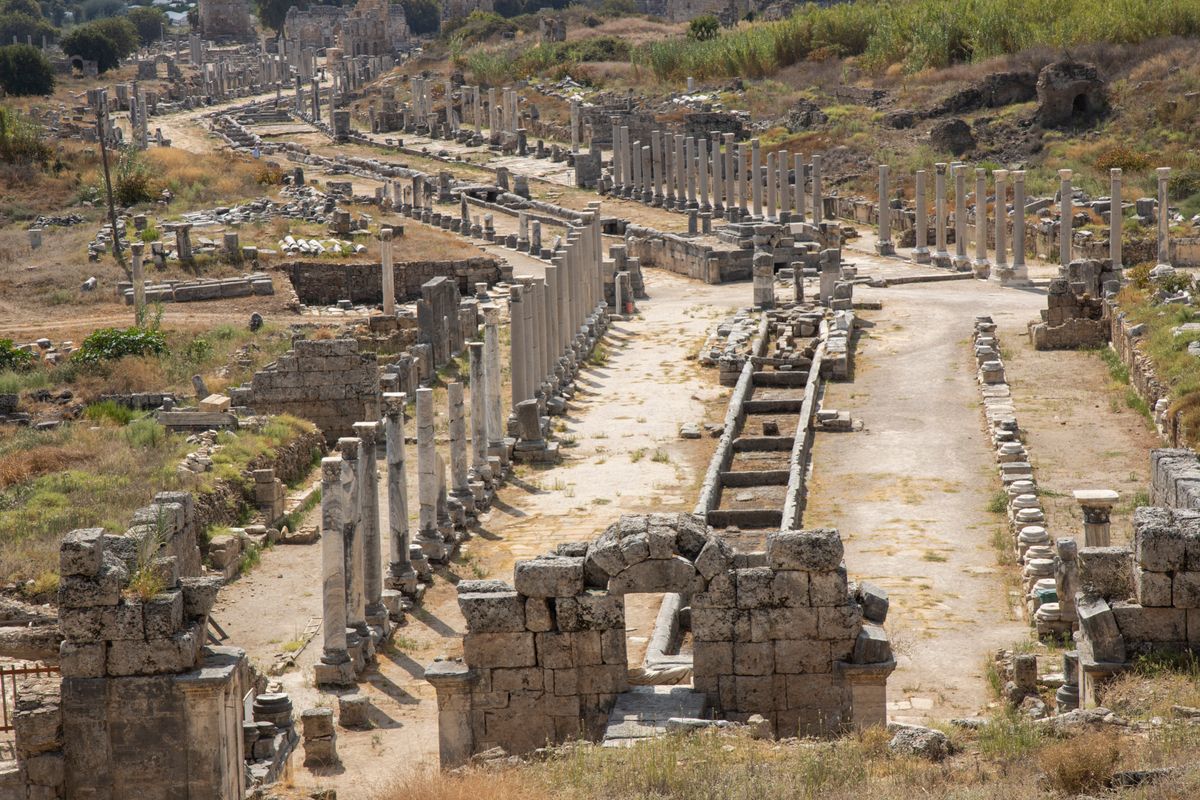
Perge: the city you walk, not the city you photograph
Perge, only about 17 kilometres east of Antalya, works differently. There is no single show-stopper to point a camera at. Instead there is scale — a whole Roman city you can wander for the better part of an hour and still not feel you've covered. You enter through the Hellenistic gate, two fat round towers of honey-coloured stone, and from there a long colonnaded street runs dead straight into the distance, with a shallow water channel cut down its centre to keep the avenue cool.
Off to the sides: the baths, where you can still read the layout of hot and cold rooms in the broken walls; the agora; and a vast stadium that once held a crowd. It is the kind of place where you start picturing the people. The grooves worn into the paving, the shop thresholds, the drain covers — Perge is detail, not drama.
Aspendos gives you one perfect thing in five minutes. Perge makes you earn its reward over an hour. We'd never choose between them — that's exactly why they pair so well.
One honest warning, and it's the same one the guidebooks bury: many of Perge's finest pieces are not at Perge. The best statues — gods, athletes, emperors — were lifted long ago and now stand in the excellent Antalya Archaeological Museum in the city. If you love Perge, go see them there afterwards; the site and the museum are really two halves of one visit. Lonely Planet's rundown of Perge is a fair sketch of what's left on the ground.
Termessos: the one Alexander gave up on
Termessos is the wild card, and the most romantic of the three. It sits about 34 kilometres north-west of Antalya, high up on a mountain saddle inside Güllük Dağı national park, ringed by pine forest. This was a city so well-defended by its sheer position that Alexander the Great looked at it, decided it wasn't worth the siege, and moved on — they nicknamed it the eagle's nest. The half-wild ruins, swallowed in trees and reached by a steep, rocky climb, more than live up to that. CNN ran a nice piece on the city Alexander couldn't take if you want the full legend.
It is not a casual stop. You need a car to the gate, then real shoes and an hour or two of uphill walking to reach the theatre clinging to the slope, the scattered temples, and the tumbled necropolis where carved sarcophagi lie pitched at angles by earthquakes and time. The payoff is the theatre's view: mountains, with the Mediterranean haze beyond, and usually no one else there. Skip it in high summer if you hate heat. Make the effort if you have a free morning — it's the one you'll talk about later.
And the fourth one, with a beach attached
If clambering up mountains isn't your idea of a holiday, there's a softer option. Side sits right on the sea further east, and its ruins — a temple of Apollo on the headland at sunset, a big Roman theatre, a colonnaded street — are a five-minute walk from the sand. Do an hour of antiquity, then go swimming. It's the least demanding of the four, and for families often the most popular for exactly that reason.
How to actually do this
The realistic ways to see these sites are a hire car or a guided day tour. There is no neat public-transport route that strings them together, and the ruins sit out among the fields and hills, not in town. A couple of things worth knowing before you go:
- Pair the eastern three. Aspendos, Perge and Side all sit on the eastern side of Antalya and combine into one neat loop — easily a full day with a car, or a single organised tour.
- Termessos is its own trip. It's in the opposite direction (north-west) and needs a car plus decent shoes. Don't try to bolt it onto the eastern loop in one day; you'll rush and regret it.
- Go early. There is almost no shade at Aspendos or Perge, and the stone radiates heat by late morning. Aim for opening time, especially June through September.
- Carry water, more than you think, and something on your head. There are kiosks at the bigger sites but nothing up at Termessos.
- Wear proper footwear. Even Perge's "flat" street is ankle-twisting broken marble. Termessos is a hike, full stop.
The honest verdict
If you have one morning, do Aspendos for the theatre and Perge for the scale — together they make close to a perfect half-day, and the two are only a short drive apart. Aspendos gives you the wow; Perge gives you the wander. Add Side if you want to fold in a swim, and treat it as the relaxed bookend rather than the main event.
Save Termessos for the day you're feeling energetic and the weather is kind. It is the hardest to reach, the least convenient, and the most likely to be empty when you get there — and that combination is precisely the point. Some ruins you tick off. That one you climb into and remember.