Coast towns
Side: the temple, the theatre and the sand
Say it "see-deh," not "side." It is the one place on this coast where you can read a 2,000-year-old inscription in the morning and be in the sea by lunch — if you can forgive the gauntlet of carpet shops in between.
Most ruins in Turkey ask you to imagine the town that once stood around them. Side does the opposite — the modern town never left, it simply moved into the old one. Shops, ice-cream counters and fish restaurants spread along the same grid the Romans laid down, the harbour still works, and at the far tip of the peninsula a line of marble columns catches the last of the light over the water. Touristy, loud in July, and genuinely lovely once the coaches have gone.
It sits about 65 km east of Antalya, roughly an hour by road, on a narrow finger of land running maybe a kilometre out to sea. That geography is the whole story. The ancient city filled the peninsula; the modern resort filled it again on top. You park outside, walk in through a Roman gate, and from there it is all on foot.
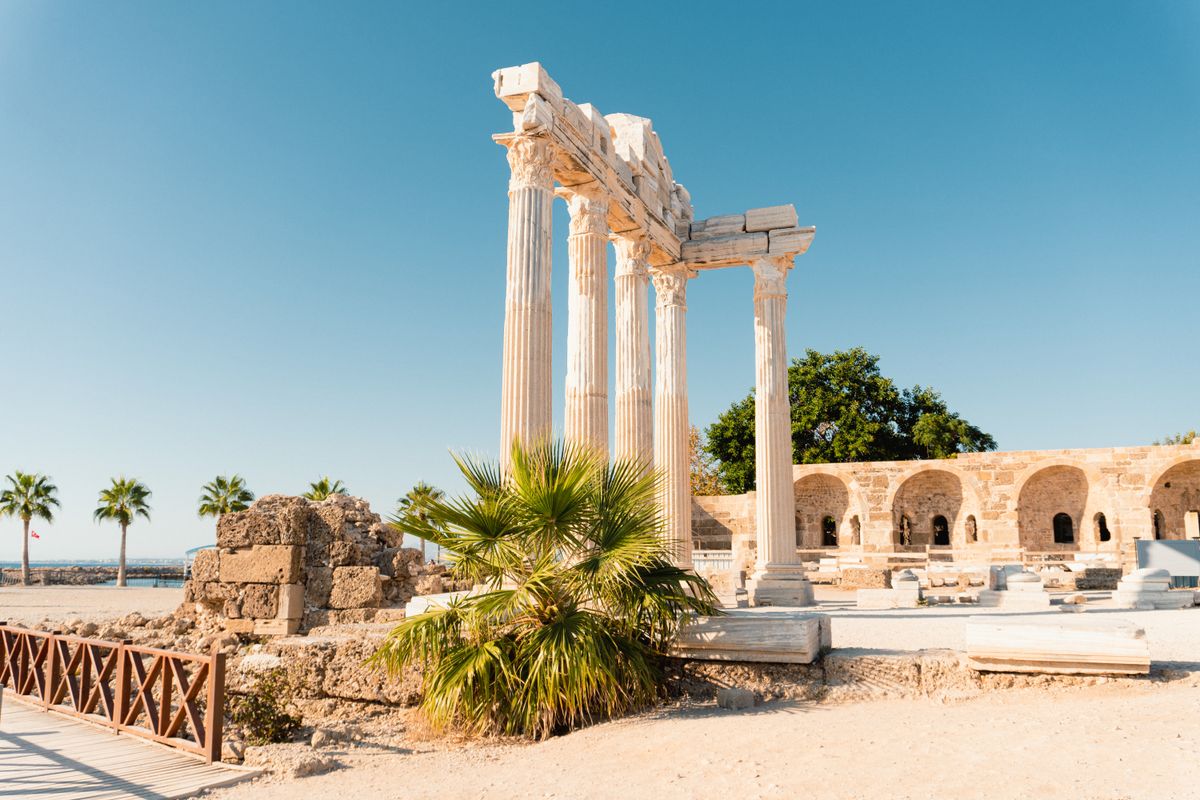
The temple everyone comes for
The Temple of Apollo is the postcard, and the postcard does not lie. Five re-erected Corinthian columns stand on the headland with the sea directly behind them, and when the sun drops they shift from white to honey to a deep amber that never photographs quite as well as it looks. Built around the 2nd century AD, it was put back up from the rubble in the modern era — a careful reconstruction rather than something that survived intact. Doesn't matter. The setting carries it.
Go at the very start of the day or the very end. Mid-afternoon you share the rope barrier with a few hundred people and the light is flat; by dusk the crowd thins to couples and tripods, and the columns do their trick. It costs nothing to stand there — no ticket booth, the temple sits in the open part of town — which is part of why it is always busy.
The theatre, the agora and the bits people skip
Walk back from the point and the serious archaeology begins. Side's Roman theatre is the heavyweight: a steep bowl of stone seating that held something like 15,000 people, built in the mid-2nd century AD on the bones of an earlier Hellenistic one. Unlike the theatre at Aspendos, which leans against a hillside, this one was raised on its own vaulted arcades — you can see the arches propping up the back rows — because the peninsula gave the builders no slope to use. One of the largest on this coast, and worth the ticket.
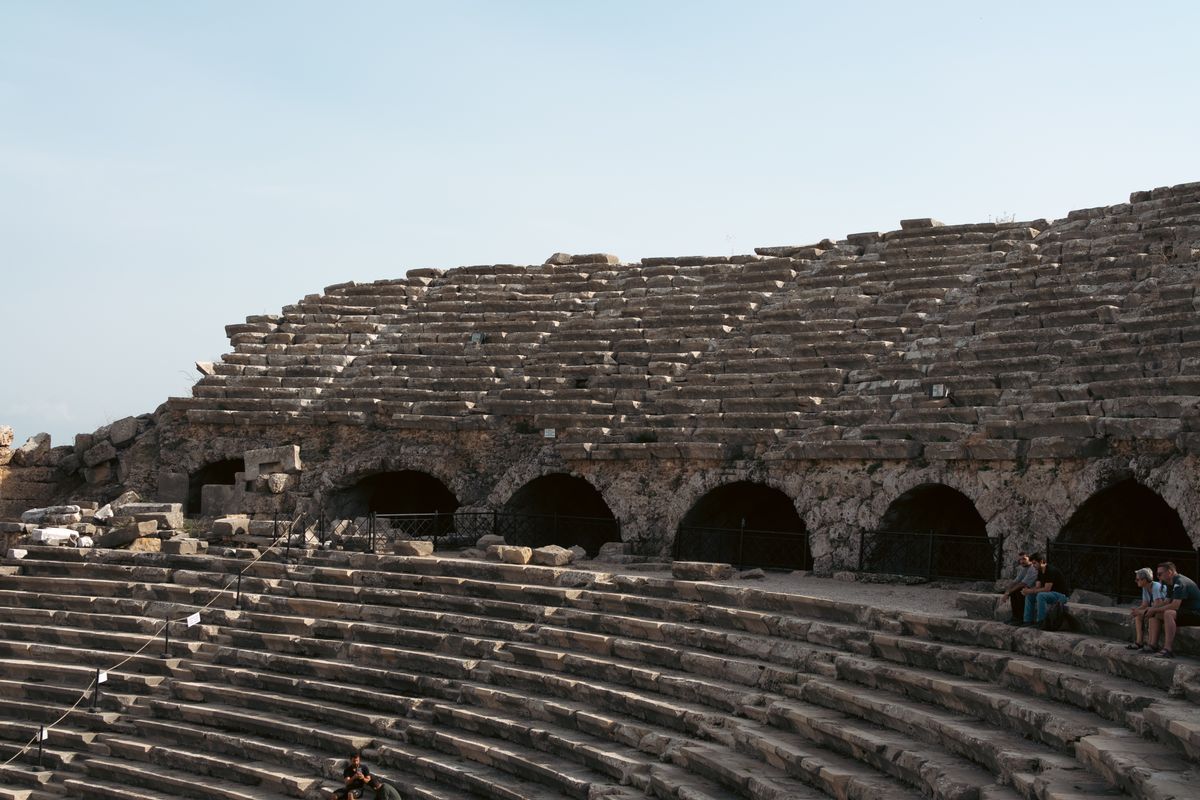
Around it spread the agora — the old marketplace, where a round building has been read as a temple of Tyche — plus the colonnaded main street and a monumental gate where the city wall met the road in. A lot of this reads as low foundations and scattered column drums unless you slow down and look. The long arcades reward people who like to wander; if ruins are not your thing, you will have ticked the box at the theatre and the temple already.
Do not miss the small museum, housed in the city's 2nd-century Roman baths — the right kind of overlap, Roman sculpture displayed inside a Roman building. The collection of statues, sarcophagi and reliefs is better than its size suggests, and it gives you an hour out of the sun. For the archaeological background on the temples and the wider site, the Turkish Archaeological News write-up beats any signboard on the ground.
Treat the ruins and the resort as two towns that happen to share an address. Come for the stones at eight, come back for dinner at eight, and spend the bleached middle of the day on a beach lounger.
Where the actual beach is
The peninsula has sand on its flanks, but the real beaches are the long strands that run away on either side, and they are where the hotels cluster.
- East — Sorgun. Quieter, backed by umbrella pine, running several kilometres toward the Manavgat river. Big resorts hide behind the trees here; it feels less hemmed-in than the town side.
- West — Kumköy and Çolaklı. Shallower water, broader sand, a more built-up beachfront. Kumköy is minutes west; Çolaklı, around 10 km out, is essentially its own resort belt.
- In town. There is sand right by the ruins too — swimming within sight of antiquity — but it is the busiest, least restful option.
Water quality is good, with a row of Blue Flag beaches along this stretch, so you are not choosing between clean and convenient — mostly between "next to your hotel" and "next to the columns."
Honestly, the souvenir gauntlet
Let's not pretend. Inside the pedestrianised core it is wall-to-wall shops — leather, "genuine fake" watches, Turkish delight pressed on you by the gram — and in high season the main lanes move at a shuffle. Roughly 12,000 residents host well over a million visitors across the summer, and you feel every one of them at 6pm on a July evening. If your idea of ruins is solitude and birdsong, Side in August will annoy you.
But the bustle is also the point of difference. This is not a fenced site you visit and leave; it is a living town built into one, with a harbour, a working evening and good grilled fish at the water's edge. Arrive early, see the stones in the cool, swim through the heat, and come back when the columns light up and the day-trippers have gone. Do that, and the souvenir shuffle becomes a small price rather than the whole experience.
A note on shopping: prices on the main lane are aimed at the package crowd. Step one street back, or buy the same Turkish delight from a supermarket in Manavgat, and it costs a fraction. Nobody is offended by a polite "no, thank you."
Doing it in a day, and what to bolt on
Side pairs naturally with the inland ruins, since you are already out this way and the great sites are close. A common loop is Side plus Aspendos and the ancient cities — the colossal theatre at Aspendos is barely 40 minutes off, and Perge sits on the same axis back toward Antalya. A full, hot day; bring water and start early.
Getting here is straightforward: about an hour from the airport, with most people either pre-arranging a car door-to-door or using a hotel's own transfer. That first run from the terminal is worth sorting before you fly, and we cover it in the airport-to-the-coast guide. Once you are based out here, local minibuses (dolmuş) shuttle between Side, Manavgat and the beach districts cheaply enough that a car is optional.
For hours, ticket info and the occasional summer concert held in the theatre, the regional pages at Antalya Tourist Information stay reasonably current, while Lonely Planet's Antalya overview sets Side in context against the rest of the Riviera.
So, the verdict. If you only have time for one coastal town between the ruins and the sand, this is the all-rounder — proper Greco-Roman archaeology, a real beach on either flank, and a centre that is alive at night, all at once, which almost nowhere else on this coast manages. Just go in knowing the columns share their town with a thousand carpet shops, and time your visit around the light rather than the lunch rush.