Beaches & nature
Olympos, Çıralı and the Chimaera flames
A Lycian city falling apart among the reeds, a quiet beach where the turtles still come, and a mountain that has been on fire for as long as anyone can remember. All in one small valley.
About an hour and a half south-west of Antalya, the main road climbs over the Beydağları and drops, in a long set of switchbacks, toward the sea. The resorts thin out, the billboards stop, and you reach a junction with a couple of signs and not much else. Turn down here for the two halves of the coast's most atmospheric corner: Olympos on one side of a small headland, Çıralı on the other. Above them both, a mountainside quietly burns.
We'll be honest about what this place is and isn't. It is not slick — narrow roads, pebble rather than powder, a young crowd filling the Olympos valley in high summer for the camps and cheap beer. But you can stand among two-thousand-year-old walls with your feet in a river, walk five minutes onto an empty beach, and after dark climb to a slope of natural flames that inspired a Greek myth. Few corners of the Mediterranean stack all three within walking distance.
Olympos: a city the trees took back
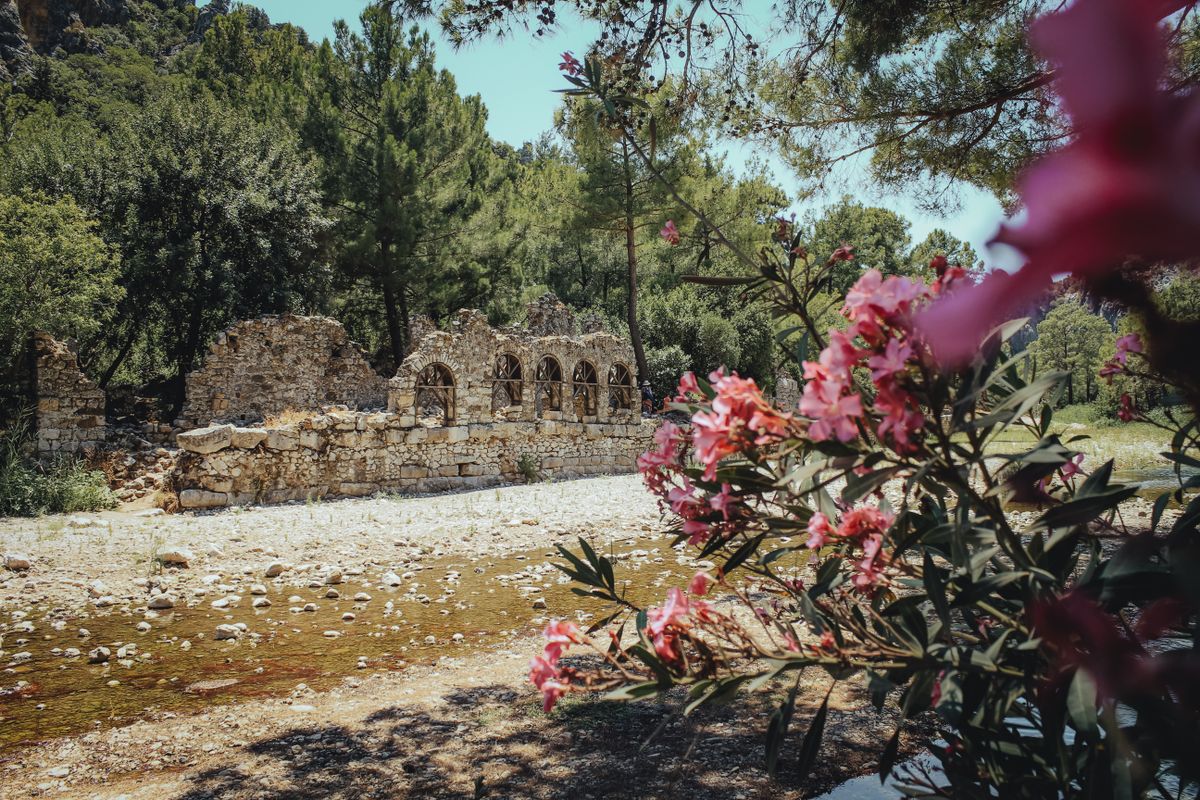
Olympos was one of the leading cities of the Lycian League, a Hellenistic foundation that carried on under Rome and slowly emptied out over the centuries after. What's left is not a tidied-up park with rope barriers and an audio guide. It's a scatter of walls, arches, tombs and a half-buried theatre down a wooded valley, a stream running through and reeds climbing over the stonework. Buy a ticket at the upper gate and then more or less wander.
That wildness is the whole appeal. Round a bend and there's a Roman doorway standing alone, framed by pines; a carved sarcophagus sits half in the water. Near the river mouth, hunt for the famous tomb with a ship carved into it and a poem for a long-dead sea captain. Then the path delivers you, almost without warning, onto the beach. Few ruins anywhere end like that.
The other half of Olympos's reputation is the accommodation. The valley made its name decades ago as a backpacker legend, built on wooden "treehouse" and bungalow camps strung along the road behind the ruins. The treehouse part is mostly marketing now — timber cabins on stilts, not platforms in the canopy — but the camps are real, sociable and cheap, and many include breakfast and dinner. Want quiet? Wrong side of the headland. Want a bonfire with people from a dozen countries? Very much the right one.
Çıralı: the quiet half, and the turtles
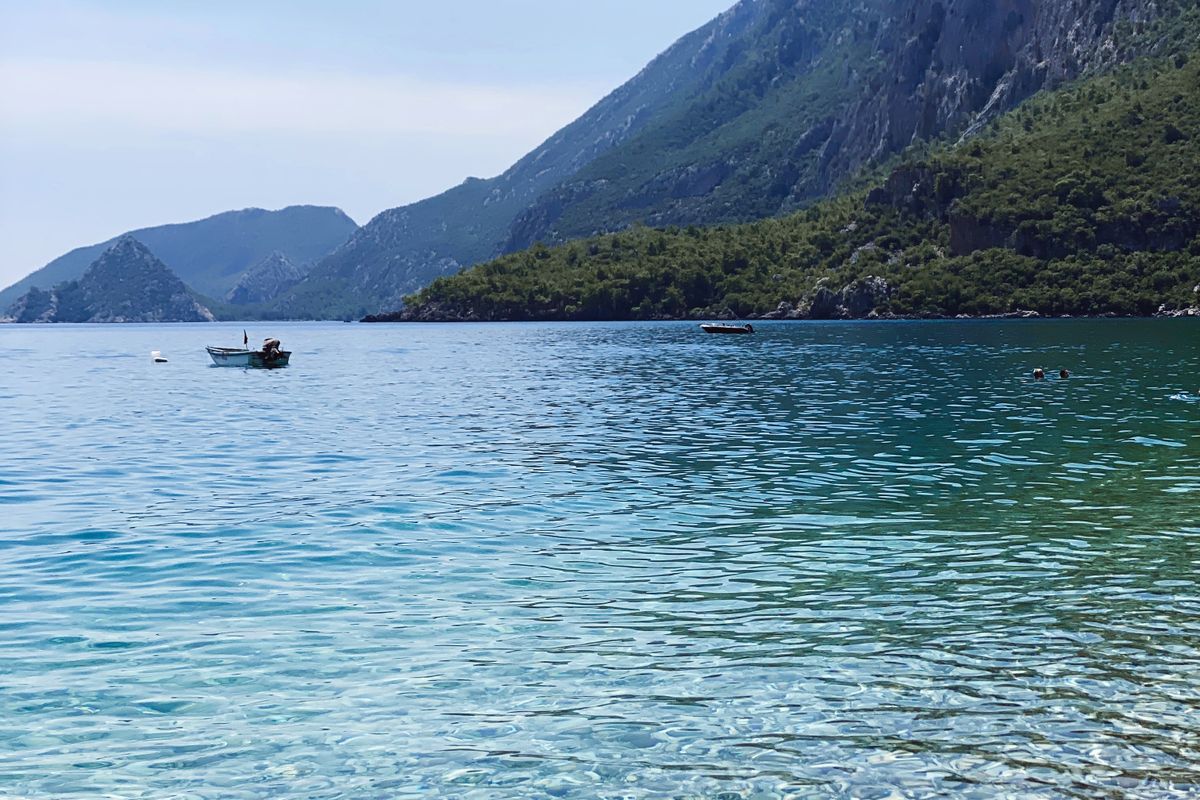
Walk along the beach away from the ruins, ford the shallow stream at the river mouth (usually ankle-deep), and you cross into Çıralı. The difference is immediate. No camps, no bars along a strip — just a scattered village of low-rise family pensions set back among orange groves, one rough road, and a long arc of pebble beach that stays calm when the rest of the coast is heaving.
There's a reason it stayed low-rise. The whole beach is a protected loggerhead-turtle nesting strip inside the Olympos–Beydağları national park, and that quietly shaped the village. Building near the sand is restricted, nests are marked off and watched through summer, and the night-time rules are real: keep your distance from marked nests, no bright torches or phone lights pointed at the beach after dark, no digging. The turtles nest from roughly May; the hatchlings emerge in the weeks that follow.
Staying the night? Ask your pension about marked nests on their stretch and the current rules. The volunteers who watch this beach do quiet, unglamorous work, and one careless light or a sandcastle in the wrong spot can undo a season of it.
Çıralı is the side we'd send most people to. Same turquoise water, same length of beach — you just trade the camp noise for cicadas and a family running a few rooms behind the lemon trees. It makes a calmer base than the big resorts up the coast; the contrast with the package strip around Kemer and the pine-backed coast could hardly be sharper, and that's the point of coming all this way.
The Chimaera: a mountain that's been alight for millennia
This is the reason the valley sticks in your memory. On the rocky slope above Çıralı, a cluster of small flames burns straight out of the bare mountainside — no campfire, no wood, just fire coming up through cracks in the rock. The Turkish name is Yanartaş, the "burning stone." Gas, mostly methane, seeps up and ignites in the open air, and has done so, by the best estimates, for well over two thousand years.
Put a flame out and it slowly comes back.
The ancients had a better story. This slope was tied to the legend of the Chimaera — a fire-breathing creature, part lion, part goat, part serpent — slain by Bellerophon on the winged horse Pegasus, then buried beneath the mountain where it goes on breathing fire. Stand there after dark, flames flickering off the rock, and you understand exactly how that myth got started.
Come back after dark. In daylight the flames are pale, almost shy, easy to walk past. After sunset, on a slope with no other light, they do something to the rock and to everyone standing around them — voices drop, phones come out, and nobody quite wants to leave.
Getting up there is a walk, not a climb — but a real one. From the car park and ticket gate above the village, a stone path switchbacks through pine forest to the lower cluster of flames in roughly twenty to thirty minutes, with more fires scattered higher if you keep going. How to do it without regret:
- Go for dusk. Start up the path so you reach the flames as the light fades — a safe climb in daylight, then the full show as it gets dark.
- Bring a torch or head-torch for the way down. The one thing people forget. The path is uneven, the forest is properly dark once the sun's gone, and your phone won't last the descent.
- Wear proper shoes. Loose stone and tree roots, not a promenade. Leave the flip-flops at the pension.
- Take water and a few coins for the gate. There's a small entrance fee, and it's warm work even in the evening.
- Marshmallows are a thing. Shops in Çıralı sell them precisely so you can toast them over the flames. Silly, and entirely worth it.
Getting there, and how long to stay
By car it's straightforward: the coast road south from Antalya through Kemer, then the signed turn-off and that winding descent to the junction. Without a car, take a Finike-, Kumluca- or Kaş-bound minibus from Antalya's bus station, tell the driver you want the Olympos–Çıralı junction, and pick up a local dolmuş for the last few kilometres to the sea — more frequent in summer. For the bigger picture, see our guide to getting around the Turquoise Coast.
One thing worth saying: this isn't a half-day stop you tack onto something else. The ruins, the beach and the Chimaera each want time, and the flames are best after dark — so stay the night, ideally in Çıralı. A full day and an evening is the minimum; two or three lazy nights is better, and the kind of thing people quietly extend once they're there.
So, the honest verdict. Ruins to lose yourself in, a protected beach the turtles still trust, and a mountainside of fire you walk up to in the dark — three strange, lovely things stacked in one small valley. The pebbles and narrow roads are a fair price. This is the corner of the coast we'd send a friend to first.